
Landscape plant supply · Thailand to site
Exporting Plants from Thailand
Exporting plants from Thailand — phytosanitary certificate, import permits, soil rules, container loading counts and sailing times to the Gulf and Asia.
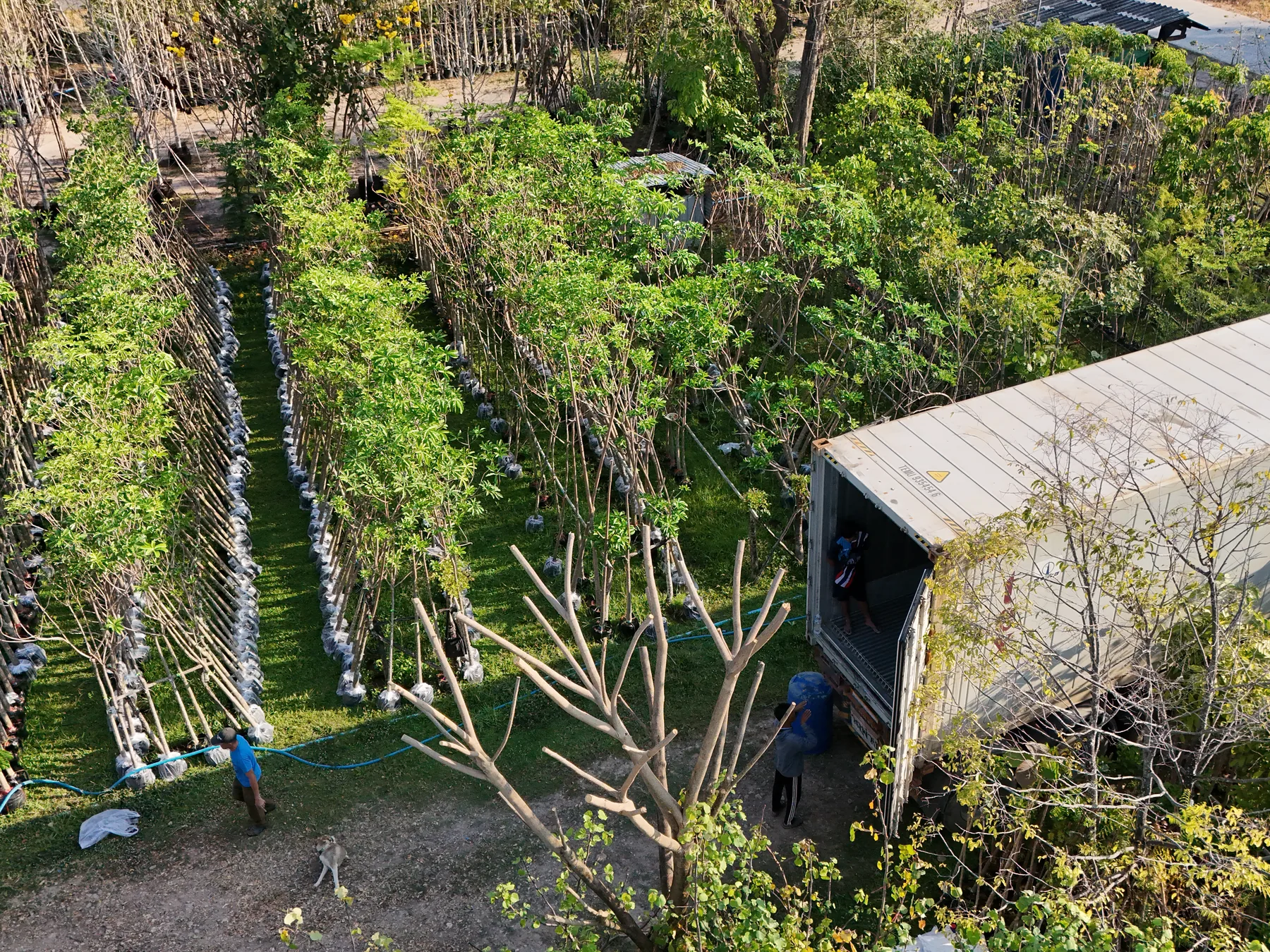
Exporting plants from Thailand is a regulated process, and what it involves depends on what is being shipped. This page sets out how it works for landscape trees: what is inspected, which documents travel with the consignment, how many trees fit in a container, and how long each stage takes — from a farm in Suphan Buri to a site in the Gulf or across Asia.
Everything on this page describes root-balled ornamental and shade trees, shipped by sea in full containers. We do not supply potted houseplants, aroids, cuttings or tissue culture, and we do not ship by air courier. Small nursery stock is routinely air-freighted out of Thailand; a tree carrying a root ball is not.
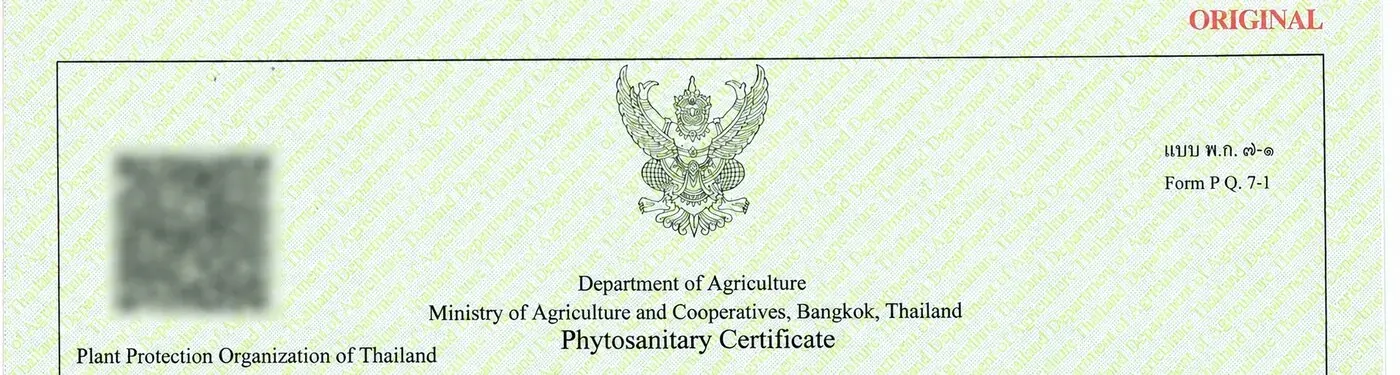
Phytosanitary certification
Every consignment ships with a phytosanitary certificate issued by Thailand’s Department of Agriculture, the national plant protection authority. It certifies that the specific consignment has been inspected and meets the plant health requirements of the destination country, and it travels with the shipment.
Where a destination requires additional treatment or declaration, that is arranged before the trees are lifted rather than at the port.
Import permits and what the buyer arranges
The phytosanitary certificate is ours to obtain. The import permit, where the destination requires one, is yours: it is issued to the party receiving the consignment, not to the exporter, and it generally needs to exist before our inspection, because the certificate is issued against the conditions the permit carries.
So send us the permit, or the conditions on it, as early as you have it. A consignment inspected without sight of a permit that turns out to carry extra conditions is a consignment stopped at the far end — and by then the trees are already at sea.
Where no permit is required for your destination, we will say so at the point of enquiry rather than leave you to establish it.
Root-balling and preparation
Trees are root-pruned in advance of lifting so the ball carries a working root system rather than a cut stump. Lifting is timed to the species’ dormancy and to the destination’s planting window.
Balls are wrapped and secured for the length of the voyage. Crown reduction is normal on evergreen species to reduce transpiration in transit.
Container loading
| Container types used | 40 ft reefer for small stock, 40 ft open top for large stock |
|---|---|
| Trees per container | By calliper band — see quantities below |
| Loading port | Laem Chabang (THLCH), Thailand |
Two container types are used, and the choice follows tree size. Small stock ships in a 40 ft reefer — it fits inside a closed container, and temperature control protects a densely packed load across a long voyage. Large stock ships in a 40 ft open top, because the trees are too tall for a closed container and have to be craned in from above.
The choice is made per consignment. It is a cost difference, and we will tell you which the trees you are ordering need.
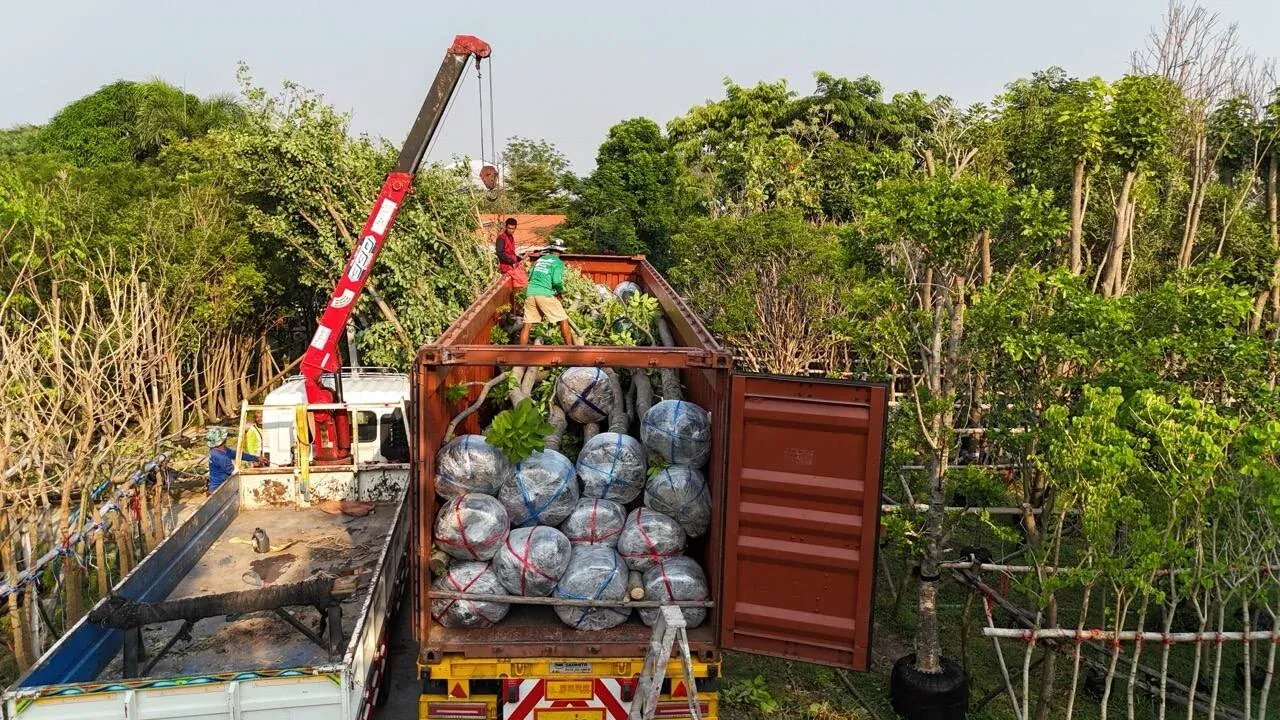
As a guide, these are the quantities we load at each calliper band. Caliper is measured 1 m above soil level.
| Caliper | Container | Trees per container |
|---|---|---|
| 5–6 cm (50–60 mm) | 40 ft reefer | 550 |
| 7–8 cm (70–80 mm) | 40 ft reefer | 400 |
| 9–10 cm (90–100 mm) | 40 ft reefer | 300 |
| 11–12 cm (110–120 mm) | 40 ft reefer | 200 |
| 15–18 cm (150–180 mm) | 40 ft open top | 60 |
| 20–22 cm (200–220 mm) | 40 ft open top | 40 |
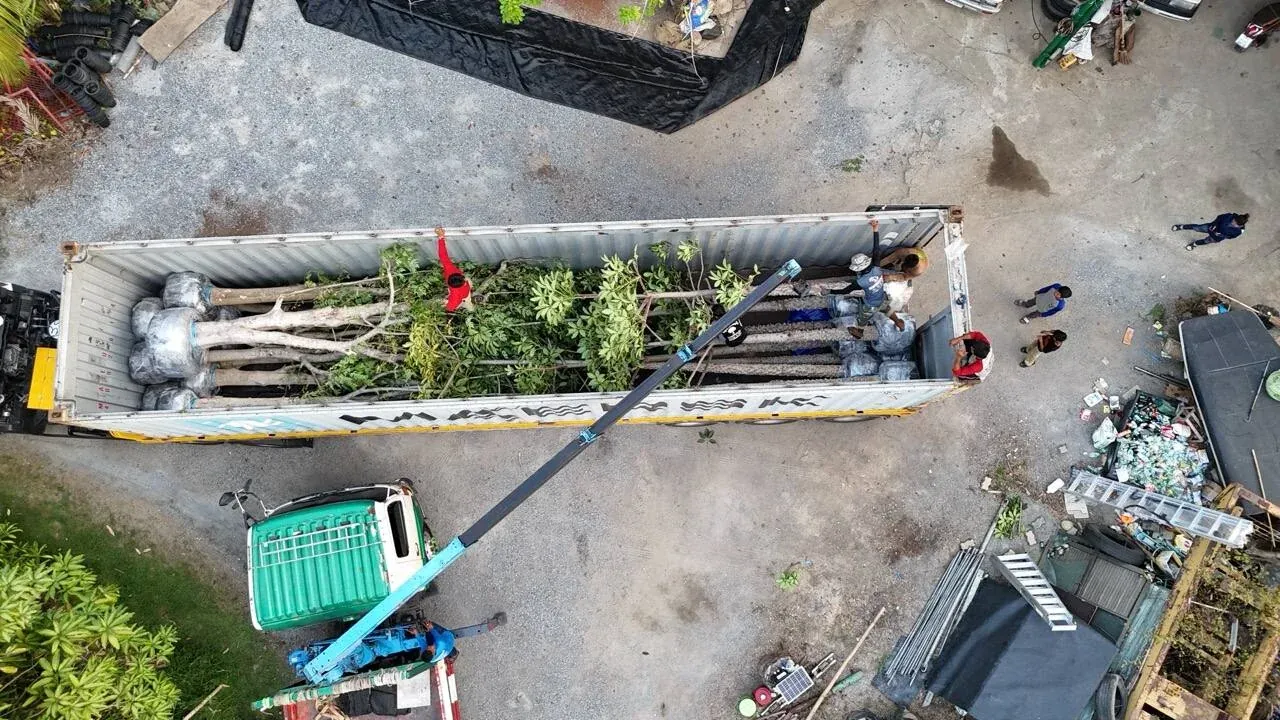
Treat these as planning figures rather than a guarantee. Two trees of the same calliper can occupy very different space depending on crown form — a narrow upright crown loads far more densely than a wide spreading one — so the final quantity is confirmed against your actual order before shipping.
Above 22 cm calliper, loading is arranged case by case. Trees at that size are handled individually rather than by a standard count, so talk to us before you build the programme around them.
Lead times
| Order to lifting | By agreement — set against your programme |
|---|---|
| Fresh stock, ready to load | 7 days |
| Trees still in ground, ready to load | Up to 120 days |
| Sailing time, Gulf ports | 14–25 days, by final port |
| Sailing time, Asian ports | 7–15 days, by final port |
| Clearance on arrival | Varies with each port’s policy |
The 120-day figure is the one to plan around. Stock already lifted and held at the nursery can be on a vessel within a week. A tree still standing in the ground has to be root-pruned, allowed to recover, then lifted and wrapped — and that preparation cannot be rushed without costing the tree its chances after planting. Where your programme is tight, tell us early and we will say honestly which species we hold ready and which need the full process.
Lead times are quoted against the season as well as the calendar. A tree lifted outside its window is a tree that arrives alive and then fails in year one, which serves nobody.
Destination requirements
Every destination sets its own terms — the responsible ministry, whether a pre-import permit is needed, restrictions on soil and growing media, and quarantine on arrival. These differ across the United Arab Emirates, Saudi Arabia, Qatar, Kuwait, Oman and Bahrain, and across the principal Asian markets, and they are revised from time to time.
We confirm the current position for your destination at the point of enquiry, and arrange any additional treatment or declaration before the trees are lifted rather than at the port.
Soil restrictions are the most common cause of a consignment being refused. Confirm the destination’s position on growing media before an order is placed, not after.
Documentation supplied
- Phytosanitary certificate
- Commercial invoice
- Packing list
- Bill of lading
- Certificate of origin
- Fumigation or treatment certificate, where the destination requires it
- CITES permit, where the species is listed under CITES
Name the species at enquiry and we will confirm which of these apply. CITES listing is species-specific and affects only a minority of ornamental trees, but where it applies the permit is additional to the phytosanitary certificate, not a substitute for it.
How a tree is measured
Every dimension in our specification tables is taken from the root collar, in millimetres. Caliper is the trunk diameter 1.0 m above it.
How the root ball is prepared
A tree drawn at 80 mm caliper has to survive the journey to be the tree you drew. Preparation is what decides that, and it is worth knowing before you specify.
The root ball is made up, not dug. Roots are cleaned and the ball is rebuilt around them — in pure coco peat below 100 mm caliper, and in roughly 30% cleaned soil and 70% coco peat above it. Every ball is shrink-wrapped with hydrogel, which holds moisture at the roots through lifting, transport and the sea passage.
There are two consequences for a specifier. The first is quarantine: below 100 mm caliper no field soil crosses the border, which matters in destinations that restrict soil on imported plants — what the UAE requires on soil and root balls is set out in full, and how the ball is built, wrapped and loaded is shown with photographs from the nursery. The second is establishment: this is a root ball, not bare root, so the tree arrives with its root system intact and in an inert medium that holds water.
Preparation is rated to hold a tree for up to 45 days in transit, well beyond the 14 to 25 day sailing to Gulf ports. If the programme slips or the vessel is late, the specification still holds.
Root balls are sized in proportion to the tree. Where a planting specification calls for a particular root ball size, or names a standard, tell us at the design stage and we will prepare to it.
Questions asked before a first order
How long does it take to export trees from Thailand?
Stock already lifted and held at the nursery can be loaded within seven days. A tree still standing in the ground needs up to 120 days, because it has to be root-pruned, allowed to recover, then lifted and wrapped. Add 14 to 25 days sailing to Gulf ports, or 7 to 15 days to Asian ports, and whatever clearance the destination takes on arrival.
Do I need an import permit?
That depends on the destination, and where one is required it is issued to you as the importer rather than to us. Tell us at enquiry which country and port the trees are going to and we will confirm the current position before an order is placed.
Is soil allowed in the root ball?
Below 100 mm caliper the ball is built in pure coco peat, so no field soil crosses the border at all. At 100 mm and above it is roughly 30% cleaned soil and 70% coco peat. Soil and growing-media restrictions are the most common reason a consignment is refused on arrival, so this is worth settling before the order rather than after.
Can plants be exported from Thailand by air?
Small nursery stock is, routinely. A root-balled landscape tree is not — it is too heavy and too large for air freight, and the preparation is built around a sea passage. Our trees ship in 40 ft containers out of Laem Chabang.
Which documents travel with the consignment?
Phytosanitary certificate, commercial invoice, packing list, bill of lading and certificate of origin, plus a fumigation or treatment certificate where the destination requires one. The full list is set out above.
Who is the exporter of record?
Asia Business Alliance Co., Ltd., a Thai company trading internationally since 2002. Thai Botanic and Thailand Tree Farm are its brands.
For requirements at a specific destination, get in touch with the country and port.